Key Takeaways
- Albino A+ is best classified as a leucistic Psilocybe cubensis variant—not a true albino—featuring pale, de-pigmented fruiting bodies with fully pigmented dark purple-brown spores.
- Spore morphology aligns with standard P. cubensis: ellipsoid, thick-walled basidiospores measuring 11–17 µm × 7–12 µm.
- The high contrast between white tissue and dark spores makes Albino A+ ideal for phase-contrast microscopy, spore print analysis, and pigmentation genetics research.
- All Albino A+ spore products are not expected to contain controlled substances pre-germination based on current understanding of psilocybin biosynthesis, and spores are legal for microscopy in 47 U.S. states.
- Lab-grade microscopy spore syringes are prepared in HEPA-filtered cleanrooms, validated via agar plating, and optimized for clarity at 400x–1000x magnification.
What Is Albino A+? An Introduction to This Unique Psilocybe Cubensis Variant
Albino A+ is one of the most recognizable names in Psilocybe cubensis microscopy research. The name is slightly misleading—this variety isn’t a true albino, it’s leucistic. That distinction matters under the microscope.
Macroscopic tissues (caps and stems) appear white to cream with minimal tan tint. Yet the spores retain full pigmentation: dark purple-brown, clearly visible at standard magnifications. For researchers, that combination creates a high-contrast specimen that simplifies spore print analysis, density evaluation, and wall-structure imaging. The distinction between leucism and true albinism hinges on whether pigment-producing pathways remain functional in specific cell types—in this case, the spore-producing basidia retain full activity.
| Feature | Detail |
|---|---|
| Genetic Lineage | Reportedly derived from classic A+ cubensis × albino/near-albino phenotype, stabilised through community selection |
| Spore Morphology | Ellipsoid, thick-walled basidiospores |
| Spore Dimensions | 11–17 µm × 7–12 µm |
| Spore Color | Dark purple-brown (standard P. cubensis pigmentation) |
| Fruiting Body Appearance | Leucistic—white to cream, highly de-pigmented |
| Recommended Magnification | 400x–1000x |
Genetically, Albino A+ is commonly described as descending from a hybrid cross between the classic A+ lineage and an albino or near-albino phenotype. This lineage is based on community cultivation records rather than peer-reviewed documentation. Generations of selective stabilisation produced a variety with predictable spore load and consistent morphology—two traits that matter when running comparative strain studies across multiple fields of view.
Placed alongside tropical isolates like the Malabar variety, Albino A+ highlights how selective breeding for pigmentation affects spore architecture independently of geographic origin.
When supplied in lab-grade spore syringes, spores are suspended in sterile research-grade solution prepared under cleanroom conditions. Each syringe features a precision-measured multi-spore suspension optimized for examining architecture, surface textures, and fine structural details at high magnification. For guidance on using mushroom spores effectively under the microscope, proper slide preparation and spore deposition technique are essential.
Storage: Refrigerate at 2–8°C (35–46°F), sealed, away from light. Storing spore syringes properly ensures viability holds up to 12 months under these conditions. Typically available as 10 mL sterile spore syringes, spore vials, prints, or swabs.
Albino A+ vs True Albino: Understanding Leucistic Characteristics
Many researchers assume “Albino A+” means true albino genetics. It doesn’t. Within Psilocybe cubensis taxonomy, Albino A+ is best classified as a leucistic lineage—partially depigmented fruiting bodies that still produce normally pigmented spores.
| Trait | Leucistic (Albino A+) | True Albino |
|---|---|---|
| Fruiting body color | White to cream | White to translucent |
| Spore print color | Dark purple-brown | Clear to very light |
| Spore visibility (400x–1000x) | High contrast, easily resolved | Requires phase-contrast or careful lighting |
| Pigment pathways | Intact at spore level | Near-total suppression |
| Microscopy difficulty | Standard | Advanced |
If you’re examining spore architecture or pigmentation at 400x–1000x magnification, leucistic Albino A+ gives you optimal contrast without specialized lighting setups. True albino lines demand phase-contrast microscopy techniques and careful focus to achieve comparable resolution.
What Does Leucistic Mean?
In Psilocybe cubensis genetics, “leucistic” refers to a mutation causing partial pigment loss in fruiting bodies while preserving pigment production in spores. For researchers working with spore prints for microscopy, the simplest diagnostic is straightforward: if a ghost-white fruit produces a dark print, it’s leucistic—not truly albino. This parallels leucistic phenotypes documented across other organisms, where melanin or pigment synthesis remains active in certain tissues while being suppressed in others.
Physical Characteristics and Appearance of Albino A+
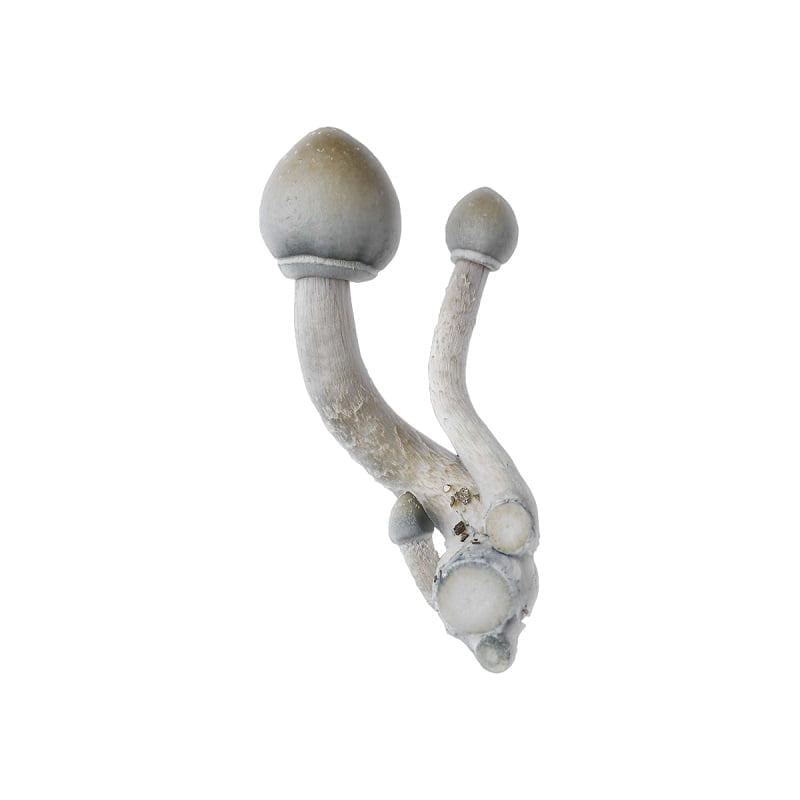
Albino A+ is one of the most visually striking Psilocybe cubensis variants available for microscopy research. Caps appear pale white, cream, or chalky—depending on developmental stage. Stems are elongated, slender, and similarly pale, occasionally displaying faint bluish bruising at stress points.
| Morphological Feature | Albino A+ Observation |
|---|---|
| Cap Color | Pale white to cream; occasional subtle translucency |
| Cap Shape | Convex (early) → flattened (maturity) |
| Surface Texture | Smooth, minimal ornamentation |
| Stem Structure | Elongated, slender, pale |
| Bruising Response | Faint bluish discoloration at stress points |
Cap morphology progresses from convex during early development to planar at maturity. Under certain lighting, caps exhibit subtle translucency—a characteristic that aids photomicrographic documentation. The smooth surface provides a uniform backdrop for comparative imaging.
Fruiting Body Features
Fruiting bodies maintain their ghostly, chalky appearance throughout development—from early primordia through maturity. This pale presentation is sometimes confused with the ghost psilocybin mushroom strain, though the two lineages have distinct genetic backgrounds and differ in spore characteristics.
Bluish discoloration at handling points confirms active enzymatic pathways in the tissue, a useful marker during macroscopic documentation. These consistent traits translate into predictable spore load and reliable specimen collection across batches.
Spore Production and Microscopy Research Value
Albino A+ earns its place in the lab for one critical reason: reliable, high-density spore production that translates directly into clearer slides and more consistent data.
Environmental variables during spore formation—temperature, humidity, oxidative stress—directly impact viability and observation quality. Research on thermal and oxidative stress in fungal spores confirms that environmental controls are critical for preserving structural integrity:
| Storage Factor | Impact on Microscopy Quality |
|---|---|
| Heat spikes above ~40–42°C | Degrades wall structure; distorts morphometric data |
| Humidity fluctuations | Promotes clumping; reduces field-of-view clarity |
| UV / direct light exposure | Accelerates pigment degradation |
| Stable refrigeration (2–8°C) | Preserves architecture and viability up to 12 months |
When these variables are controlled, differences observed at magnification reflect genetics and environment—not handling artifacts. That distinction is everything in comparative strain studies.
Cleanroom-prepared spore syringes eliminate the noise. Dense, well-hydrated suspensions give you even spore distribution, minimal debris, consistent density, and contamination-free clarity. Researchers quantifying spore shape and wall thickness across multiple cubensis variants need this level of standardization—any variation from contamination or thermal degradation skews the dataset.
Albino A+ Potency: What the Research Shows
Researchers frequently ask where AA+ lands on the alkaloid spectrum. Formal peer-reviewed head-to-head comparisons by strain remain limited, and published quantitative analyses of psilocybin-producing fungi demonstrate that growing conditions, substrate composition, and post-harvest handling often exert more influence on alkaloid content than strain label alone.
| Factor | Observation |
|---|---|
| Intra-strain variability | High — individual specimens within the same lineage differ significantly |
| Phenotype clustering | Albino/leucistic lines are frequently reported in the mid-to-upper potency tier by community datasets |
| Primary influence | Growing conditions, substrate, and post-harvest handling — often more impactful than strain label |
| General P. cubensis tryptamine range (dried fruit) | ~0.5–1.5% by weight across all cubensis varieties |
Community-sourced reports generally place Albino A+ in the medium-to-high range for cubensis, though this has not been confirmed in peer-reviewed strain-specific trials. Any specific grow can land above or below typical ranges depending on genetics, substrate, temperature, and dehydration methods. Strain labels remain poor predictors of alkaloid concentration when examined rigorously.
For microscopy research, none of this applies. Ungerminated spores are not expected to contain psilocybin, psilocin, or other scheduled compounds based on current understanding of tryptamine biosynthesis pathways, which activate in developing fruiting body tissue rather than in dormant spores. Potency discussions relate exclusively to mature fruiting bodies—not to spores examined under the microscope.
Common Confusion: Albino A+ vs Albino Penis Envy
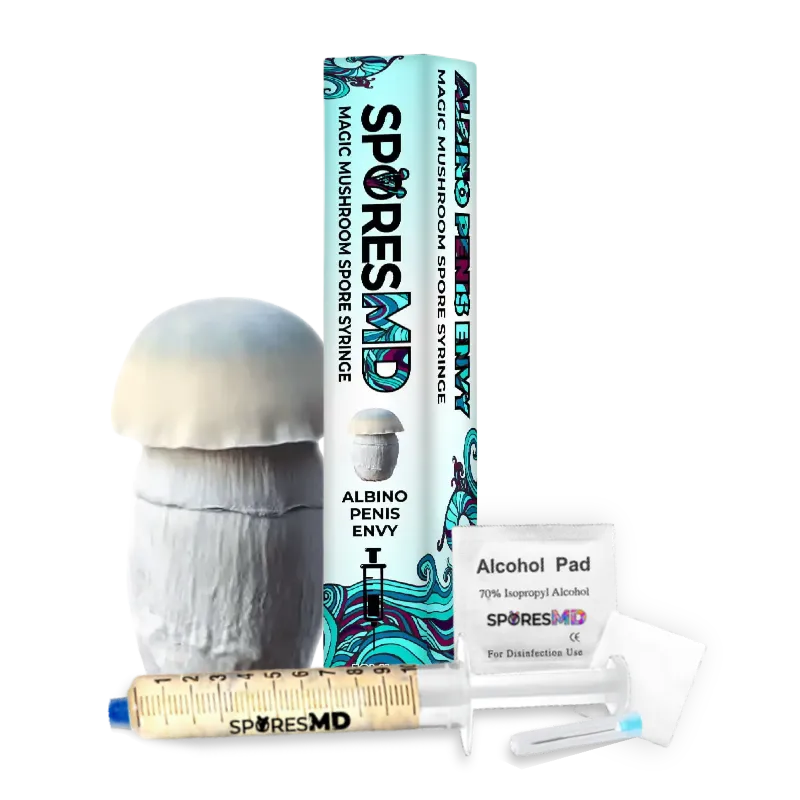
Both Albino A+ and Albino Penis Envy (APE) are white-appearing Psilocybe cubensis varieties. The similarities end there. For researchers asking what is albino penis envy, the key distinction comes down to pigmentation type.
Albino A+ is leucistic—spores retain standard dark purple-brown pigmentation. APE, derived from the penis envy mushroom lineage, expresses true albinism—near-total pigment loss across tissues and spores. That single distinction changes your entire imaging workflow.
| Feature | Albino A+ | Albino Penis Envy (APE) |
|---|---|---|
| Pigmentation Type | Leucistic (partial loss) | True albino (near-total loss) |
| Spore Color | Dark purple-brown | Very light / near-clear |
| Brightfield Visibility | High contrast, easy to resolve | Low contrast, requires adjustment |
| Recommended Technique | Standard brightfield or phase-contrast | Phase-contrast strongly recommended |
If someone recommends “albino cubensis spores” without specifying which variety, ask. The microscopy experience differs significantly between these lineages.
Available Albino A+ Product Formats: Liquid Culture, Spore Vials, and More
Which format best serves your research goals? Understanding the difference between spore syringe vs liquid culture is the first step in selecting the right tool for your workflow.
| Format | Primary Research Application | Contents | Storage |
|---|---|---|---|
| Spore Syringe (10 mL) | Spore morphology, pigmentation, germination patterns | Dormant spores in sterile solution | 2–8°C, up to 12 months |
| Liquid Culture (10 mL) | Hyphal network analysis, mycelial growth dynamics | Live mycelium in nutrient media | 2–8°C, use promptly |
| Spore Print / Swab | Density comparison, custom suspension prep | Deposited spores on foil or sterile swab | Cool, dark, sealed—12+ months |
If your research centers on spore-level morphology, a spore syringe gives you the cleanest starting point. If you’re studying post-germination dynamics—hyphal architecture, branching angles, colonization vigor—liquid cultures for microscopy eliminate the germination wait entirely. Note that live mycelium products may be subject to different legal considerations than dormant spores in some jurisdictions—always verify your local regulations before ordering.
SporesMD ALBINO A+ Mushroom Liquid Culture (10ml)
Our 10 mL Albino A+ liquid culture ships as a sealed luer-lock syringe with sterile needle included. Each batch is filled in a HEPA-filtered cleanroom, screened for sterility and viability, and clarity-optimized for immediate microscopic inspection of hyphal networks.
Frequently Asked Questions About Albino A+
Is Albino A+ a true albino strain?
No. It’s leucistic—fruiting bodies show significant pigment reduction, but spores retain standard dark purple-brown coloration. Spores resolve easily under brightfield without specialized contrast adjustments.
What can I observe under the microscope?
Spore architecture (ellipsoid shape, wall thickness, surface ornamentation), pigmentation density, size distribution (11–17 µm × 7–12 µm), and germination behavior where legally permitted. For detailed protocols, see our guide on how to germinate mushroom spores.
Do Albino A+ spores contain controlled substances?
Based on current understanding of psilocybin biosynthesis, ungerminated spores are not expected to contain psilocybin, psilocin, or other scheduled compounds, as these tryptamines are synthesized in developing fruiting body tissue. Under federal scheduling law (21 U.S.C. §812), psilocybin and psilocin are controlled—not the spores themselves. Spores are legal for microscopy in 47 U.S. states and Washington D.C. Restrictions apply in California, Georgia, and Idaho. Always verify your local laws.
How should I store my spore syringe?
Refrigerate at 2–8°C, store in darkness, never freeze. Expected viability is up to 12 months with aseptic handling.
Can I use Albino A+ for cultivation?
All SporesMD products are sold strictly for research and microscopy purposes. Cultivation or any attempt to produce controlled substances is not supported or condoned.
What equipment do I need?
A compound microscope (400x–1000x), glass slides and coverslips, and sterile pipettes for spore deposition. Phase-contrast optics and a laminar flow hood are optional but recommended for enhanced detail and contamination-free transfers.
How does Albino A+ compare to other cubensis strains for microscopy?
Its primary advantage is contrast between leucistic tissue and fully pigmented spores—ideal for comparative pigmentation genetics studies alongside standard-pigmented varieties like the golden teacher mushroom strain or B+. For a deeper dive into strain differences, explore our Psilocybe cubensis spore syringe catalog.