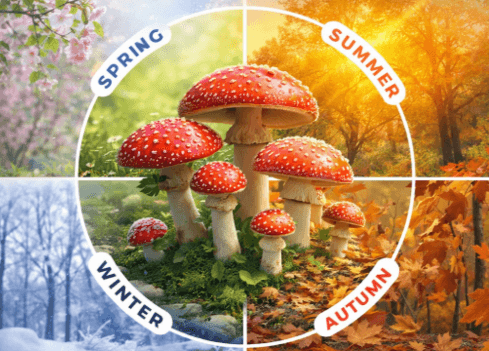
Fungi are found all around us, but their growth and behavior shift with the seasons. People may see changes in spore germination, mycelial growth, and fruiting without realizing how much the seasons matter. Learning about these effects can make each observation more organized and useful.
Learning how seasonal effects on fungal development influence growth allows observers to plan and track cultures more effectively. Using strain-specific products, such as Golden Teacher Mushroom Liquid Culture or Lion’s Mane Organic Mushroom Liquid Culture, makes observations more consistent and engaging. Observers can see how different strains respond to temperature, humidity, and light throughout the year.
Seasonal awareness also helps maintain cleaner, more reliable cultures and supports deeper insight into fungal diversity. Tracking growth through each season reveals subtle adaptations and encourages a greater appreciation for mushroom mycology.
Seasons Shape Fungal Life in Observable Ways
Temperature, humidity, and light availability vary with the seasons and influence fungal biology at every stage. Spore germination, mycelium expansion, and fruiting respond subtly to these environmental cues. Observing these changes highlights how fungi adapt to their surroundings and supports a more detailed understanding of mushroom mycology.
You can see how the seasons affect fungi in both natural and controlled settings. For example, liquid culture lets you keep conditions steady while still noticing small changes from seasonal air temperature and humidity. Taking care of liquid cultures means watching where you place containers, adjusting room humidity, and keeping temperatures stable for healthy growth.
Spring Awakening: Rapid Growth and Expansion
Spring usually brings more moisture and warmer weather, which helps mycelium grow early. Spores often germinate faster, and mycelial networks spread quickly when there’s plenty of nutrients and humidity. You might see stronger hyphal growth in liquid cultures and faster colonization in mushroom kits.
Tips to monitor spring growth include:
- Track daily expansion of mycelium in clear containers or observation jars
- Record temperature and humidity to correlate growth speed with environmental conditions
- Compare multiple cultures to see how different strains respond to early-season conditions
- Use Microscopy Liquid Culture Syringes and Microscopy Spores for clean and observable early growth
Spring provides a valuable opportunity to see how fungal life takes advantage of favorable conditions, and documenting growth now helps refine future seasonal observation techniques.
Summer Activity: Balancing Growth with Environmental Stress
Summer heat and fluctuating humidity can make it difficult to maintain stable cultures. Mycelium may slow expansion or change growth patterns in response to these stressors. Observers gain insight into how fungi adjust structural growth, resource allocation, and network density under less predictable conditions.
Tips for observing summer fungal activity include:
- Ensure containers remain cool and away from direct sunlight
- Monitor for condensation inside jars that may affect visibility
- Maintain consistent handling to prevent accidental contamination
- Functional Mushrooms and All-In-One Mushroom Grow Bags provide controlled observation environments to track seasonal changes
Understanding summer growth patterns highlights the resilience and adaptability of different strains. Liquid culture and spore studies during this season can reveal traits that are not as visible in more stable conditions.
Autumn Growth: Preparing for Fruiting and Diversity
In autumn, fungi often switch from growing to reproducing. Cooler temperatures and shorter days signal to the mycelium to begin forming fruiting bodies, demonstrating how fungi use their resources wisely. This season is a good time to spot small differences between strains and explore fungal diversity with mushroom kits or liquid culture syringes.
Tips for autumn observation include:
- Track early signs of fruit body formation in clear containers
- Note differences in color, texture, and density between strains
- Compare observations with spring and summer growth patterns to understand seasonal shifts
- Use Microscopy Prints or Microscopy Swabs to capture samples for detailed study
Autumn provides a clear opportunity to observe how environmental signals influence fungal reproduction and variation, offering valuable insight into mushroom mycology.
Winter Dormancy: Slower Growth and Strategic Observation
In winter, you might not see much fungal activity, but the mycelium is still adapting below the surface. You can watch for small hyphal growth and structural changes during the colder, darker months. Taking care of liquid cultures is especially important now, since temperature changes and indoor heating can affect how fungi grow.
Tips for winter observation include:
- Maintain steady temperatures in observation spaces using incubators or insulated shelves
- Track slow hyphal growth and document any structural changes in the mycelial network
- Compare multiple strains to see how resilience varies under low-energy conditions
- Functional Mushroom Kits, Culinary Mushrooms, and Golden Teacher Mushroom Liquid Culture are excellent tools for winter study
Winter observation offers a unique perspective on fungal strategy and survival, deepening understanding of seasonal effects on fungal development.
Understanding Strain Differences Across Seasons
Different fungal strains exhibit varied responses to seasonal cues. Some strains germinate quickly in spring, while others exhibit slow, deliberate growth year-round. Observers can use strain-specific liquid cultures, such as Albino Penis Envy Mushroom Liquid Culture, to systematically study these differences.
Tips to compare strain responses:
- Record growth rate, color changes, and hyphal density for each strain
- Use consistent environmental tracking to isolate seasonal influence
- Observe multiple cultures to identify patterns in resilience, structure, and colonization
- Integrate both Microscopy Liquid Culture Syringes and Spore Syringes for complementary insights
Tracking these differences supports a structured approach to fungal biology and highlights the diversity inherent in mushroom species.
Practical Tools to Support Seasonal Observation
Maintaining clean and organized observation setups enhances learning throughout the year. Using sterile containers, labeled cultures, and structured documentation helps observers notice subtle shifts in growth patterns. Tools like Microscopy Prints, Microscopy Swabs, All-In-One Mushroom Grow Bags, and Liquid Culture Syringes create opportunities to monitor fungal life safely and effectively.
Tips for practical seasonal management:
- Schedule consistent observation intervals
- Label all containers with strain, date, and relevant environmental notes
- Use clear containers to track mycelial network expansion
- Rotate functional mushroom kits and culinary liquid culture syringes to compare seasonal effects
Employing these tools allows observers to see how fungal life adapts to seasonal changes while keeping cultures clean and organized.
Observing the Rhythm of Fungal Life
Fungal growth is closely tied to seasonal shifts in temperature, humidity, and light. Integrating observations with practical tools like spore syringes, liquid cultures, functional mushroom kits, and culinary liquid culture syringes creates a hands-on learning experience that reveals the diversity and adaptability of fungi.
Observers who track these changes gain a deeper understanding of spore germination, mycelial expansion, and fruiting patterns. Check out our full range of spore syringes, liquid cultures, and mushroom kits to explore how the seasons affect fungi and build your mycology skills.